
Why Your Multilingual Blog Is Invisible to AI Search (And How to Fix It)
Having content in 23 languages doesn't make you visible in AI search. The rules changed in 2026 — here's what actually works now.
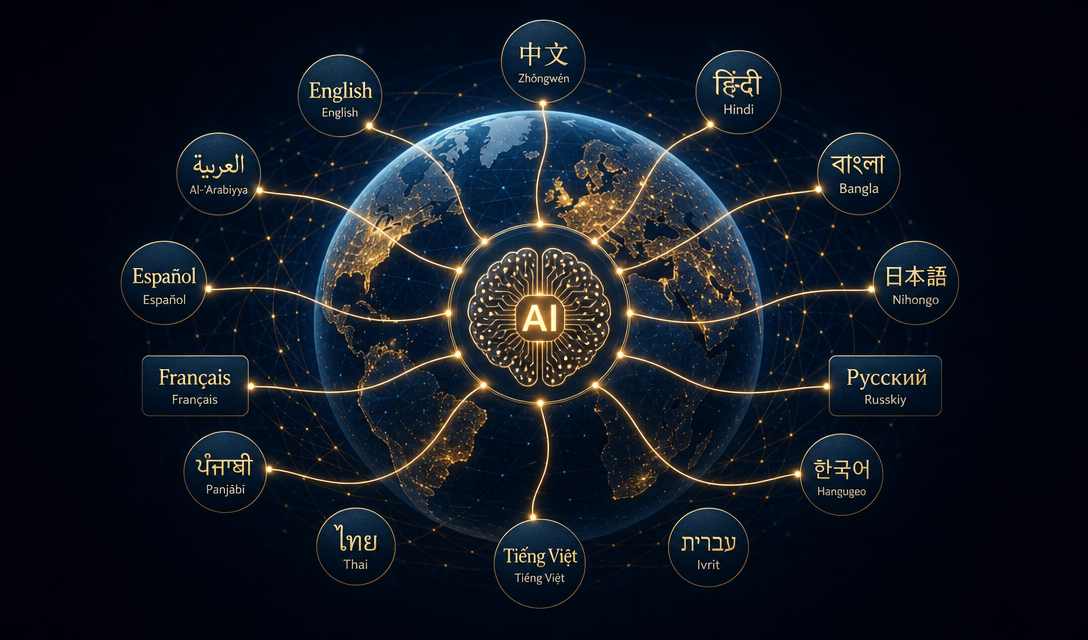
Here's something counterintuitive I discovered while building out my 23-language blog: having content in 23 languages doesn't automatically make you visible across 23 languages in AI search. Not anymore.
The game has fundamentally changed in 2026 — and most developers building multilingual content have no idea it happened.
The Old Assumption Was Wrong
Traditional international SEO operated on a simple premise: Google reads hreflang tags, routes Japanese users to your Japanese page, German users to your German page. You optimize each page for local keywords. Done.
That model is breaking down. AI search systems — Perplexity, Gemini AI Overviews, ChatGPT Search — don't work like Google's routing system. They're synthesis engines. They extract facts across languages and synthesize answers on the fly.
The practical consequence: a significant portion of citations in non-English AI Overviews now originate from English-language sources. Your Japanese page isn't automatically the source for Japanese AI search results just because it exists.
Hreflang tags are invisible to AI extraction systems entirely.
What AI Systems Actually Evaluate
LLMs aren't matching keywords. They're evaluating entities and facts that transcend specific languages. An AI search engine reading about your product doesn't care which language the page is in — it cares whether the underlying facts are credible, consistent, and well-structured.
This creates a new failure mode: shallow translation detection. AI models can detect when content was mechanically translated versus natively written by checking for contextual coherence. A German page that references US-centric examples without adapting them reads as inauthentic to the model. The technical SEO term for the winning approach is "Entity Localization" — not keyword translation.
The difference:
- Keyword translation: Take your English post about "AI agent memory failures" and translate it to Japanese.
- Entity localization: Write about AI agent memory failures with examples and framing that resonate with Japanese developers — different tools, different community references, different technical context.
One is a translation. The other is a post a Japanese developer would actually write.
The Structured Data Layer Nobody Is Implementing
Here's the technical gap I found when auditing multilingual sites in 2026: almost no one is implementing the Schema structured data that AI systems use to understand multilingual entity relationships.
The current recommended stack:
{
  "@context": "https://schema.org",
  "@type": "Organization",
  "sameAs": [
    "https://en.wikipedia.org/wiki/YourBrand",
    "https://www.wikidata.org/wiki/QXXXXXXX"
  ],
  "areaServed": [
    {"@type": "Country", "identifier": "US"},
    {"@type": "Country", "identifier": "JP"}
  ],
  "knowsLanguage": ["en", "ja", "zh", "de"],
  "name": [
    {"@language": "en", "@value": "Your Brand"},
    {"@language": "ja", "@value": "ブランド名"}
  ]
}
The sameAs links to multilingual Wikipedia and Wikidata entries are critical. AI models use these as trust anchors to establish that your brand is a real entity with verifiable cross-language presence — not just a site that generated translated pages.
knowsLanguage and the multilingual name field tell AI systems which languages are legitimately supported, not just which URLs exist.
Hreflang still matters for traditional Google Search. Keep it. But it does nothing for AI extraction. These are two separate systems now, and you need to serve both.
What This Means If You're Building a Multilingual Content Site
I build on a 23-language stack, which means I've had to rethink the whole pipeline:
The translation layer isn't enough. Mechanical translation creates content that AI search will deprioritize because it's detectable as shallow. The quality bar is native localization — not just linguistic accuracy, but contextual relevance. This is harder and slower, but it's the only thing that works.
Entity authority needs to be built intentionally. If your brand doesn't exist on Wikidata, add it. If your key technical concepts aren't linked to their Wikipedia equivalents via structured data, AI systems have no reliable way to verify your entity claims. This isn't optional anymore.
English content still punches above its weight. Because a significant portion of non-English AI citations come from English sources, your English-language technical posts act as a citation anchor across languages. Write the strongest English version first, structure it with clear entities and facts, and let it do work in AI search results across language markets.
The long-tail opportunity is real but different than expected. I originally thought 23 languages meant 23x the SEO surface area. It does — but only if each language market has genuinely localized content, not translations. The opportunity is especially strong in markets where English content dominates AI search results: Japanese, Korean, German developers are underserved by local-language AI search results.
The Honest Assessment
Building multilingual content is harder in 2026 than it was two years ago — not because the tools got worse, but because the quality bar got higher. AI-generated translation farms that worked in 2024 are being filtered out. The bar is now: would a native developer in this market actually find this useful?
If yes, you have a durable advantage that's genuinely hard to replicate. International SEO in the AI era rewards depth and authenticity — exactly what's hard to scale cheaply.
If you're thinking about building a multilingual technical blog and wondering whether it's worth the effort: the answer depends entirely on whether you're willing to do the localization work properly. Translated-English content won't cut it. Genuinely localized content, with the right structured data backing it, is one of the best moats available to a solo technical founder right now.
That's the bet I'm making with this site. We'll see how it holds up.
شارك هذا
بقلم Feng Liu
shenjian8628@gmail.com