The Portfolio Founder: How AI Turned Me Into My Own VC
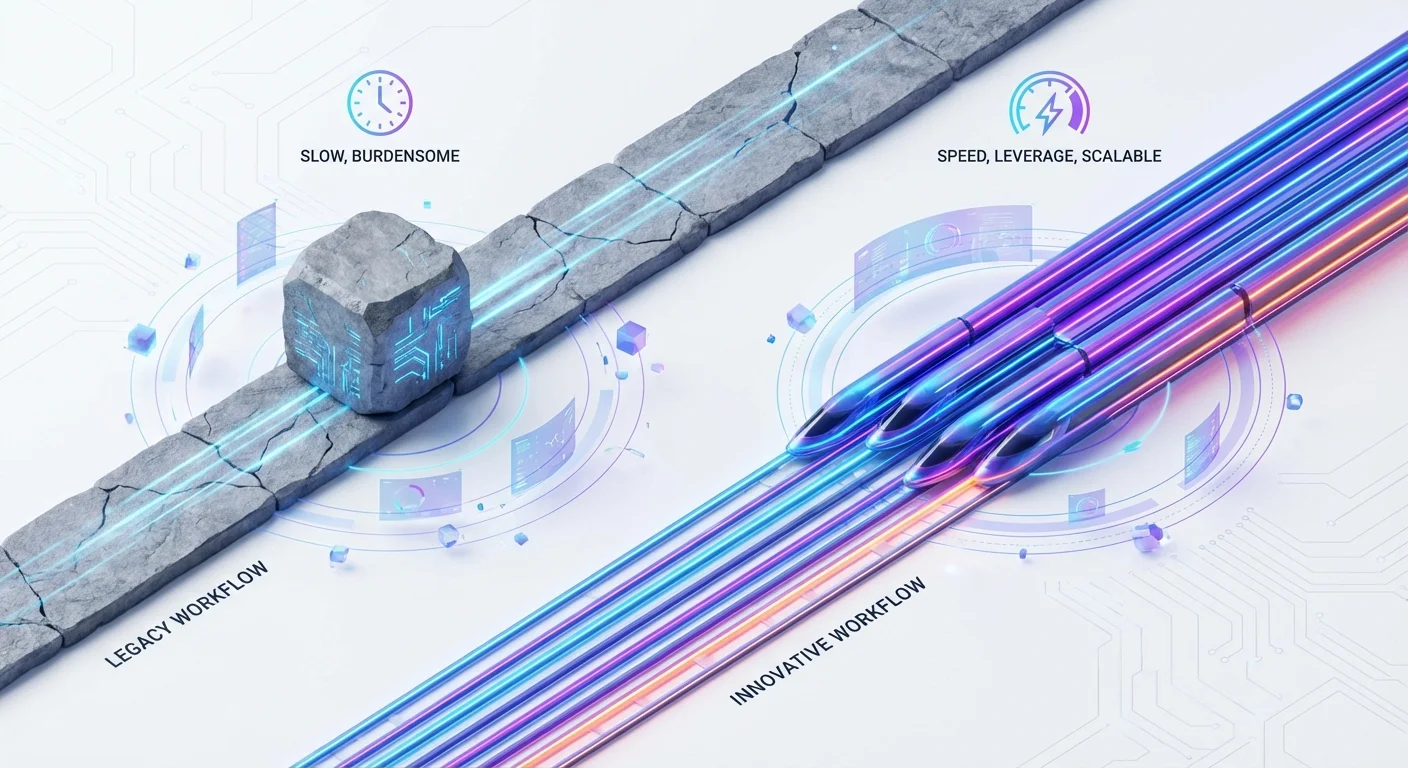
The traditional startup mathâ2 years of funding, 4 pivotsâis dead. With AI leverage, you don't need 3 months to test an idea; you need a weekend. Here is how to validate 10 ideas in parallel and become your own investor.

I did the math the other day, and it honestly terrified me.
Back when we were building our first SaaS products, the cycle was brutal but predictable. Youâd pitch investors, secure 18 to 24 months of runway, hire a small team, and start the grind. Youâd spend three months building an MVP, another month launching, and two more interpreting the data. Best case scenario? You find out your baby is ugly in six months.
If you were lucky and disciplined, a standard Seed round bought you maybe four real shots on goal. Four pivots. Four chances to find that elusive Product-Market Fit before the money ran out and you had to go back to a corporate job.
That was the reality for the last decade. It was linear, expensive, and stressful.
But recently, I realized something that shifted my entire mental model: The cost of a "bullet" has dropped to near zero.
We are entering an era where you donât need to be a serial entrepreneur anymoreâdoing one thing after another. You can be a parallel entrepreneur. You can effectively become your own Venture Capitalist, managing a portfolio of your own experiments, all built with 10x leverage.
Here is what Iâve observed, and how this changes everything for builders like us.
The Death of the 3-Month MVP
In the old world (and by old, I mean 2022), validating an idea required a "Schlep," as Paul Graham would say. You had to wireframe, set up the database, fight with CSS, write the copy, and set up the email sequences. Even for a seasoned full-stack engineer, it was a heavy lift.
Because the upfront cost of building was so high, we became emotionally attached to our ideas. We needed them to work. When you spend three months coding a feature, you donât want to hear that nobody wants it. You rationalize. You double down. You waste time.
Today, the equation has flipped.
I recently watched a friend use Cursor and v0 to spin up a fully functional dashboard in an afternoonâsomething that would have taken my team two weeks in 2018. When the cost of building drops this dramatically, the strategy changes. You stop trying to predict the winner and start playing the odds.
The New Workflow: 10x Leverage in Practice
Everyone talks about "AI coding," but thatâs just one layer of the stack. The real magic happens when you apply AI across the entire venture pipeline.
Here is what the new "Portfolio of One" workflow looks like. Iâm seeing solo founders do this right now, and itâs mind-blowing:
1. AI Research (The Analyst)
Instead of guessing what the market needs, you use AI agents to scan forums, Reddit, and G2 reviews. Youâre not looking for one idea; youâre looking for ten. You generate ten distinct problem statements based on actual user complaints.
2. AI PM (The Architect)
In the past, writing ten Product Requirements Documents (PRDs) would take weeks of thinking. Now? You feed the research into an LLM and ask it to scope the MVPs.
"Based on this user pain point, outline a Minimum Viable Product that solves the core issue in the simplest way possible. List the features, the user flow, and the data structure."
Boom. Ten roadmaps, ready to go.
3. Vibe Coding (The Builder)
This is where the rubber meets the road. You aren't writing boilerplate anymore; you are "vibe coding." You are directing the AI to implement the logic. You handle the edge cases, the AI handles the syntax.
With tools like Replit or Cursor, you can genuinely prototype ten different applications in the time it used to take to build one. You aren't worried about perfect architecture yet; you're worried about existence.
4. AI Marketing (The Distributor)
This was always the bottleneck for engineersâwe love to build, hate to sell. But now, you can spin up ten landing pages, ten ad copy variations, and ten SEO-optimized blog posts in a day. You can launch ten small experiments to see which one gets clicks.
Be Your Own VC
Naval Ravikant often talks about leverage: labor, capital, code, and media. We used to need capital (investors) to hire labor (engineers) to write code.
Now, code is the labor, and AI provides the capital efficiency.
When you can run ten experiments in parallel over three months, you are no longer a founder betting your life on one lottery ticket. You are an investor managing a portfolio.
If Idea #1 gets zero clicks? Kill it. You spent 48 hours on it. Who cares? If Idea #5 gets traction but the retention is bad? Pivot or pause. If Idea #9 suddenly starts getting organic signups? Double down.
This detachment is your superpower. In the traditional model, admitting failure was devastating because it meant wasting months of runway. In the parallel model, failure is just data. Itâs cheap.
The Trap of Mediocrity
Now, a word of caution. Iâve seen builders get drunk on this power. They ship garbageâspammy, low-quality wrappers that add no value.
Just because you can build ten things doesn't mean you should build ten clones. The goal isn't volume for volume's sake; it's volume for discovery's sake.
You still need taste. You still need empathy for the user. AI can write the code, but it can't feel the frustration of a user struggling with a complex workflow. Thatâs still your job. The AI is the engine, but you are the steering wheel.
Practical Takeaways
If I were starting from scratch today, with $0 MRR and no team, I wouldn't spend six months writing a business plan. Here is what Iâd do:
- Pick a Theme, Not an Idea: Choose a domain you know (e.g., "Productivity for Remote Teams" or "Tools for Etsy Sellers").
- The "Weekend Sprint" Rule: If the MVP can't be built in a weekend with AI assistance, it's too complex for this stage. Simplify it.
- Parallel Launch: Don't launch one by one. Build three small tools. Launch them all on Product Hunt or Reddit. See which one resonates.
- Follow the Pull: Ignore the ideas you wanted to work. Follow the one where strangers are asking you for features. Thatâs the signal.
The Best Time to Build
Iâve been in this game for over a decade. Iâve seen the mobile wave, the crypto wave, and the SaaS boom. But I have never seen a barrier to entry this low.
The gatekeepers are gone. You don't need permission, you don't need a co-founder, and honestly, you might not even need funding for a long time.
You have the tools to be the research team, the engineering team, the marketing team, and the investment committee all at once.
So, stop polishing that one pitch deck. Go build ten things. One of them might just change your life.
Share this

Feng Liu
shenjian8628@gmail.com