
Google Just Purged 45% of Low-Quality Content. Here's What Actually Survived.
Google's March 2026 update wiped 45% of low-quality content from its index. Here's what survived — and what it means for founders building content.

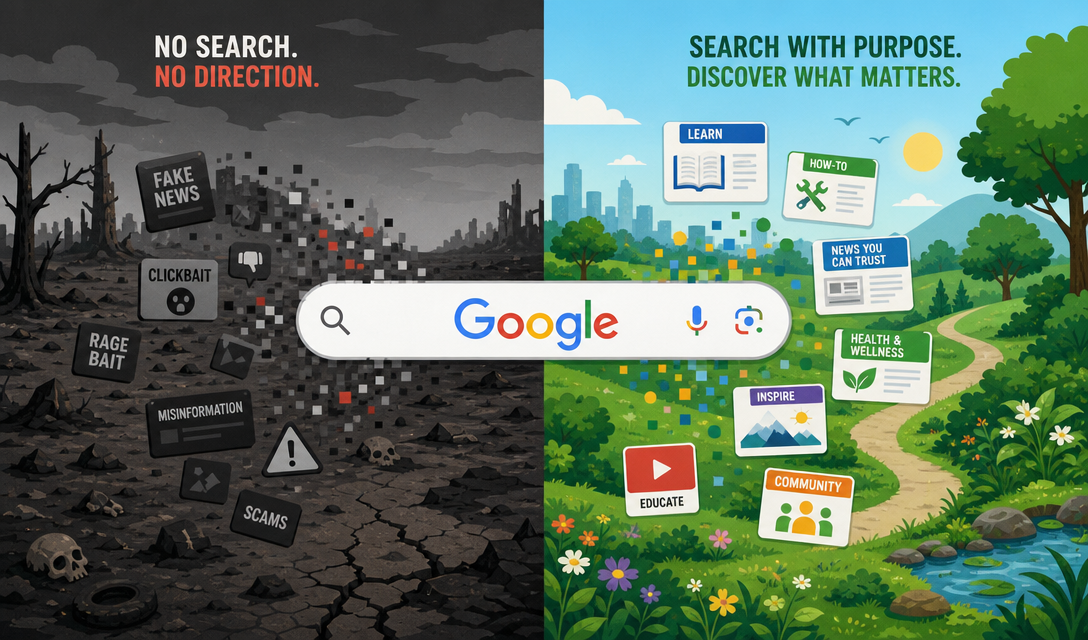
In March 2026, Google ran two major updates back to back — a Spam Update on March 24, and a Broad Core Update three days later. By the time the dust settled, Google reported that low-quality content in its index had dropped by 45%.
That's not a warning shot. That's a controlled demolition.
If you're building content as part of your SaaS growth strategy — and especially if you're thinking about how to build AI SaaS content that ranks in a world flooded with AI-generated pages — this is the most important signal of 2026 so far.
What Google Actually Targeted
The Broad Core Update in March didn't penalize "AI content" as a category. It targeted content that behaves like AI-generated content tends to behave:
- Thin, templated pages answering generic questions that AI Overviews already handle
- No first-hand experience — pages that could have been written by anyone, anywhere, without touching the subject
- Weak E-E-A-T signals — no named author, no demonstrated expertise, no original data
A large-scale analysis by Graphite covering 40,000 U.S. websites found a 2.5% year-over-year decline in overall SEO traffic. Google's own traffic, meanwhile, rose 0.8% — meaning Google got better at keeping users on Google, not sending them to thin sites.
The sites that got hit hardest were doing something specific: answering the same generic questions that an AI Overview now handles in two sentences at the top of the results page. If your page exists to answer "what is X" or "how does X work" without adding anything a model can't synthesize from Wikipedia — you just lost your traffic source.
What Survived (And Why)
The winners from the March update fall into a clear pattern. According to the Holler Digital / SEOPress analysis of winners and losers:
Case studies with real data. Pages built around proprietary information — your actual user metrics, your own experiments, things that happened to real people in real situations. A model can't make this up, and Google knows it.
First-hand experience content. The developer who documented how they ported an ARM64 compiler in 30 minutes using DeepSeek V4 Pro for $8. The founder who shared what broke when their AI agents misread micro-conversions as real revenue. These aren't generic — they're timestamped, attributed, and verifiable.
Interactive tools and niche community sites. Two developers in a r/webdev thread discussing the future of websites both landed on the same answer independently: the sites that survive are the ones offering something AI can't replicate — a tool that does something specific, or a community where real people are talking to each other about real problems.
Strong E-E-A-T signals. Named authors with verifiable track records. External links from real sources. A site that looks, feels, and is maintained by someone with actual skin in the game.
The Uncomfortable Implication
Here's what I keep thinking about: the same thing that makes AI tools useful for generating content at scale is exactly what Google is now penalizing.
If you used an AI to write 50 SEO pages with a keyword stuffed in the title, a generic intro, H2 headings that match the query, and a conclusion that says nothing — you just built the corpus that Google is actively burning down.
And this problem compounds with the GEO shift happening simultaneously. AI engines like ChatGPT, Claude, and Perplexity are increasingly where high-intent buyers start their searches. Those engines pull from a much smaller, more curated surface area than Google. Ranking #2 on Google doesn't guarantee you're in the ChatGPT shortlist. But the things that do get you cited by AI engines — structured answers, attributed data, third-party mentions — are exactly the same things that also help you survive Google's purge.
The content that wins on both surfaces is the same content.
What This Means If You're Building
If you're building a SaaS — or building your personal brand as a technical founder — this is the filter:
Does this page exist because I know something specific that I can prove? If the answer is yes, keep going. If you're writing it to chase a keyword and could have produced the same thing without ever using the product or living the experience, Google will eventually figure that out.
Some practical shifts that survive the update:
Document your actual process. Not "here's how to do X" — but "here's what happened when I did X, including what broke." Specific failure modes are the hardest thing for AI to replicate.
Name your data sources. If you cite a number, say where it came from and when. Anonymous statistics are the first sign of thin content.
Write for one person, not for a query. The March update specifically rewarded content that felt human-addressed — a specific person with a specific problem getting a useful, direct answer from someone who's been there.
Build tools that do something. A calculator, a generator, a diagnostic — even a simple one — gives your page a reason to exist that a paragraph of text can't replace.
Earn external mentions. Not through link building schemes — through publishing something worth referencing. A founder on r/EntrepreneurRideAlong noted that one well-placed, deeply helpful Reddit reply in a niche thread drove 5–10 high-intent users. That's the kind of signal that builds E-E-A-T over time.
The Bottom Line
Google's March 2026 update isn't a surprise if you were paying attention. The entire direction of the algorithm — E-E-A-T, Helpful Content, the anti-spam pushes — has been pointing at the same thing for years: Google wants to reward content that couldn't have been produced without the author's actual experience.
AI-generated content isn't disqualified on principle. But AI-generated content that shows no evidence of a human with first-hand experience — that's the thing getting wiped out.
If your content strategy is built on volume over specificity, the update already hit you or will. If it's built on documenting what you're actually doing and what you're actually learning, you're probably fine — and you're building the kind of digital presence that compounds.
That's the bet worth making.
Teilen
Geschrieben von Feng Liu
shenjian8628@gmail.com