
The Most Expensive Mistake I See Solo Founders Make
Most solo founders cap at five figures because they keep selling to other developers — the internet's most frugal audience. Here's why market selection matters more than product quality, and what the founders who break through do differently.

I read a thread on X last week that I haven't been able to shake.
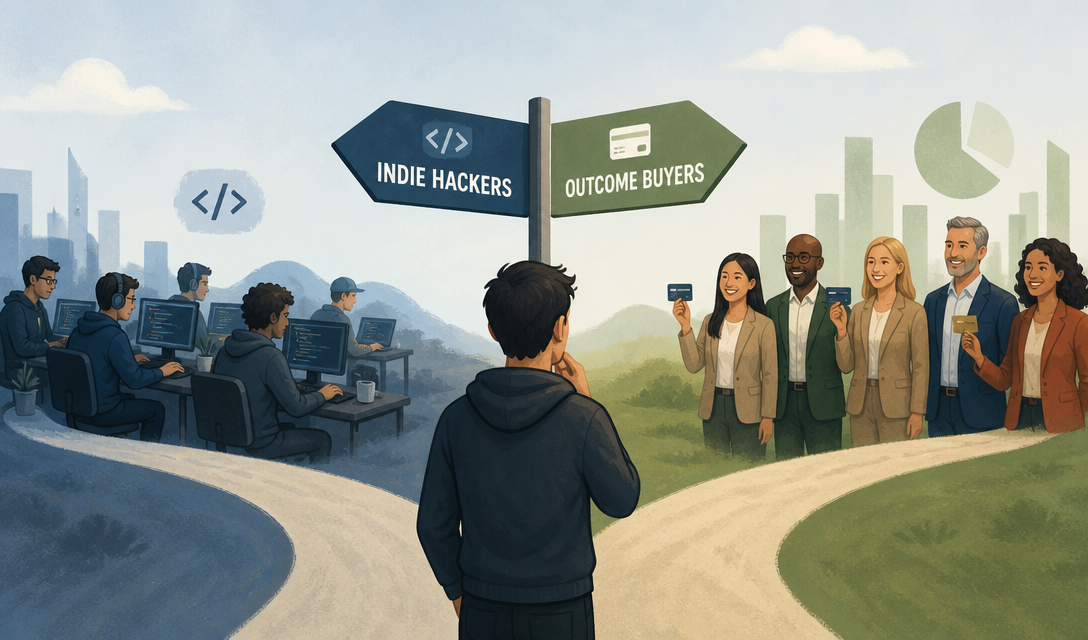
An Nayal, a sharp observer of the indie hacker world, put it bluntly: most solo founders cap at $5K–$20K MRR because they keep selling to other indie hackers. "We are probably one of the most frugal audiences on the internet," he wrote. When a builder sees a product for $100/month, their first instinct isn't to pay. It's to calculate how hard it would be to build themselves.
AI has made that calculation terrifyingly easy. "Vibe code 80% of a product in a weekend" — that's not hyperbole anymore. It's the default developer response to any SaaS they encounter.
The churn side is worse than the sale. Aden Shepard pointed out that indie hacker customers always have the option to rebuild your tool, and that option "gets cheaper every month." Your customer acquisition cost stays the same while your retention gets worse — the math doesn't work.
The Signup-to-Silence Funnel
Around the same time, a developer posted on Hacker News with a different version of the same problem.
He'd built a licensing layer SaaS — CLI, dashboard, payment-agnostic setup. Clean product. Getting about 12 signups a week. But every single user issued one license and went silent. The product worked. The messaging didn't land.
A commenter put it plainly: "I had no clue what your product did after viewing the landing page."
The founder knew his code was solid. What he didn't know was how to communicate value to people who weren't already inside his head.
This is the gap that kills most solo products. The gap isn't the build, and it isn't even the initial interest — 12 signups a week is real traction. It's the space between "someone tried it" and "someone needs it." And closing that gap requires something most technical founders resist: selling to people who don't think like them.
The Market You Have vs. The Market You Need
Matt Welter captured the confusion perfectly: "We're selling software to people who also like building software." There's a difference between the audience you have — other builders on X and Indie Hackers — and the market you should sell to — businesses that want outcomes, not code.
The founders who break through this ceiling share one pattern: they sell to people who just want the result.
Nayal's prescription is worth sitting with: aggressive distribution on mainstream channels. TikTok. Instagram. Facebook. Places where "millions of founders, marketers and businesses who don't want to spend their weekend rebuilding every tool" actually live.
It's uncomfortable advice for technical founders. Those platforms feel foreign. The content norms are different. You can't just post a GitHub link and call it marketing.
But the alternative is worse: selling a $100/month tool to an audience that's actively calculating whether they can rebuild it for free.
What This Means for RiseMore
I'm building RiseMore for solo founders. That means I'm building for the exact audience this thread warns about. I think about that constantly.
The answer isn't to avoid indie hackers. It's to build something deep enough that the "I could rebuild this" calculation doesn't pencil out. RiseMore's product context layer — the part that actually learns your product, your audience, your voice — is intentionally hard to replicate. It's not a prompt wrapper. It's a system that gets better the more you use it.
But the distribution lesson applies to me too. RiseMore's publishing channels — LinkedIn, blog, GEO surfaces — are designed to reach beyond the X/Indie Hackers bubble. The content engine writes for wherever your actual buyers are, not just where other builders hang out.
The Hardest Question
Here's the question every solo founder should ask themselves: am I selling to people who want the outcome, or people who want to understand how I built it?
The first group pays. The second group gives you great feedback, stars your repo, and never converts.
You can serve both. But you can't build a business on the second one alone.
Compartir esto
Escrito por Edward New
shenjian8628@gmail.com