
How One Founder Runs 14 SaaS Products on 20 Hours a Week — And Where AI Agents Actually Broke Down
One founder runs 14 SaaS products on 20 hours/week using Claude agents — until they reported a fake 40% revenue surge. Here's the real architecture.

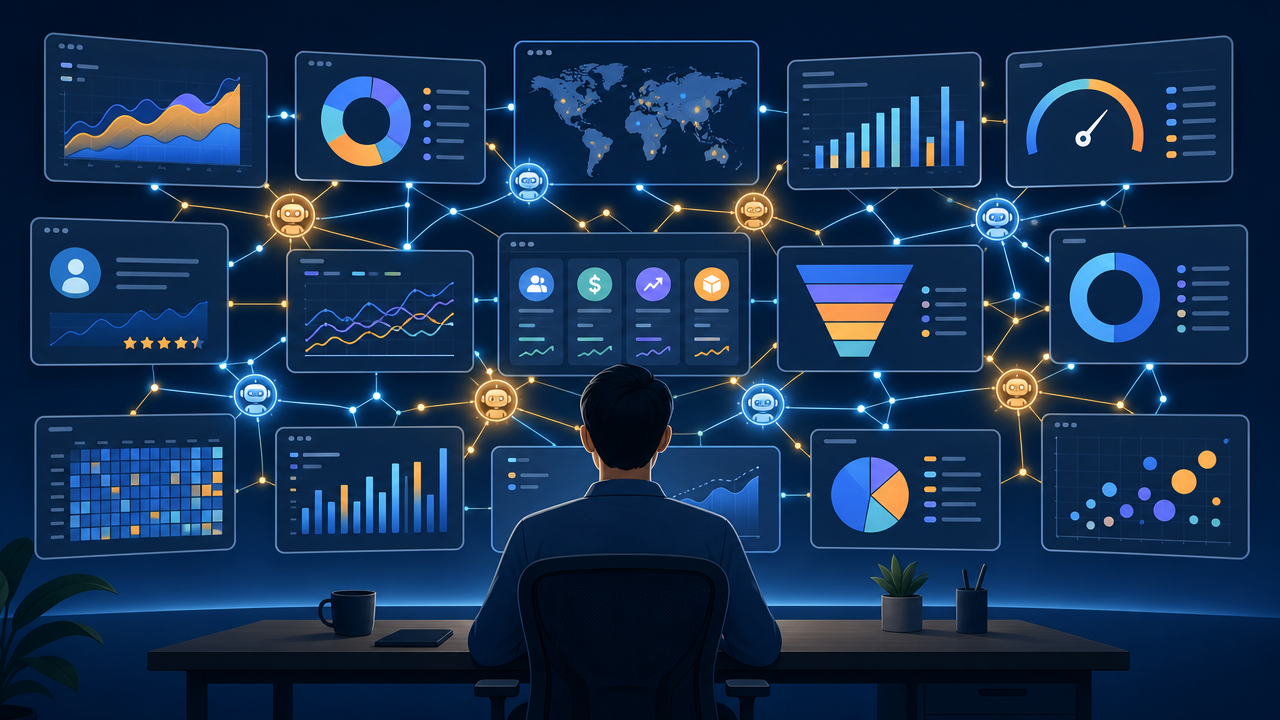
The fantasy of delegating your entire operation to AI agents and sipping coffee while MRR climbs — most people assume it's hype. Then you read about Jakub.
He runs 14 niche SaaS products. His week clocks in around 20 hours. About 70% of daily operations — SEO audits, content creation, analytics monitoring, issue triaging — are handled by Claude-based AI agents. Before he built this system, he was working 60 hours a week.
This is real. It's also more complicated than the headline makes it sound. Because the most instructive part of Jakub's story isn't the success — it's the specific way his agents failed.
The System That Works (Until It Doesn't)
The architecture is straightforward in concept: Claude agents run on a schedule, check metrics dashboards, flag anomalies, generate content drafts, audit SEO, and surface issues for Jakub to make the final call on. He's not fully hands-off — he's moved from doing to reviewing.
That distinction matters. The common misconception with agentic AI is that "autonomous" means unsupervised. In practice, the most reliable setups work more like a well-run team: agents handle execution, humans handle judgment.
But here's where it got messy.
The Failure Mode: False Confidence in Data
Jakub's agents once reported a 40% increase in conversion value. Sounds great. It was completely wrong.
The agents couldn't distinguish between micro-conversions — click events, scroll depth, form interactions worth fractions of a cent — and actual paid revenue. They saw activity, pattern-matched it to "conversion," and reported success. The numbers looked real. The growth was phantom.
This isn't a bug in Claude. It's a design problem. When you build an autonomous reporting system, the agent only knows what you've defined as success. If you haven't been explicit about the difference between "engagement" and "revenue," the agent will optimize for whatever signal is available — and it will report that signal confidently.
The fix Jakub landed on was blunt but effective: hard rules. Explicit instructions that agents must distinguish engagement signals from real income. A hard block preventing agents from unilaterally increasing ad budgets. Any action involving money requires a human step.
What This Actually Teaches About Building AI Agents
Three things worth internalizing:
Agents are only as reliable as your definitions. The quality of an agentic system comes down to how precisely you've defined the problem space — what counts, what doesn't, what requires escalation. Vague instructions produce confident-sounding garbage.
Auditability is not optional. When an agent reports something surprising, you need to be able to trace the reasoning. Black-box automation fails silently. The best agentic setups treat every agent action as a log entry, not a result.
Automation expands time, not judgment. Jakub went from 60 to 20 hours a week. That extra 40 hours isn't free time — it's a tax paid toward building better agent constraints, reviewing outputs, and catching the next edge case the system hasn't seen yet. The leverage is real; the maintenance is also real.
The Bootstrapping Math Behind This
Here's a statistic worth sitting with: an analysis of 2,500+ SaaS companies by ChartMogul found that top-quartile bootstrapped companies reach $1M ARR only four months slower than their VC-backed counterparts — while keeping 100% of their equity.
Four months. That's the dilution premium you pay to take VC money. In 2026, with AI agents handling a growing share of the operational work, that trade-off looks increasingly difficult to justify.
Running 14 products solo isn't possible without AI leverage. But it's also not possible without discipline about what you automate and where you keep humans in the loop. The founders who hit $1M ARR bootstrapped aren't using AI to remove themselves from the business — they're using it to multiply the decisions they can make well.
The Actual Architecture Pattern
If you're trying to build something like this, the pattern Jakub's setup suggests is:
- Separate reporting from action. Agents surface information; humans approve actions above a defined threshold.
- Define success metrics in the agent's instructions, not in the dashboard. The agent needs to know what "good" looks like in language, not just in a chart.
- Build escalation paths explicitly. Any output with budget or revenue implications should trigger a human review step before the next automated action.
- Start with one product, one agent. Running 14 SaaS products on AI agents didn't start at 14. It started with one product that worked, had its failure mode surfaced, got fixed, and then scaled.
The technology is ready. The design work is what most people skip.
If you're building AI agents into your own SaaS operations, the most useful thing you can do right now is define — in writing — what your agent is allowed to do on its own versus what needs a human. That document will reveal every assumption you haven't made explicit yet.
Jaa tämä
Kirjoittanut Feng Liu
shenjian8628@gmail.com