
GEO vs SEO: Why Ranking #1 on Google No Longer Guarantees You Exist
GEO vs SEO: ranking #1 on Google no longer means AI engines will recommend you. Here's what actually drives visibility in 2026.

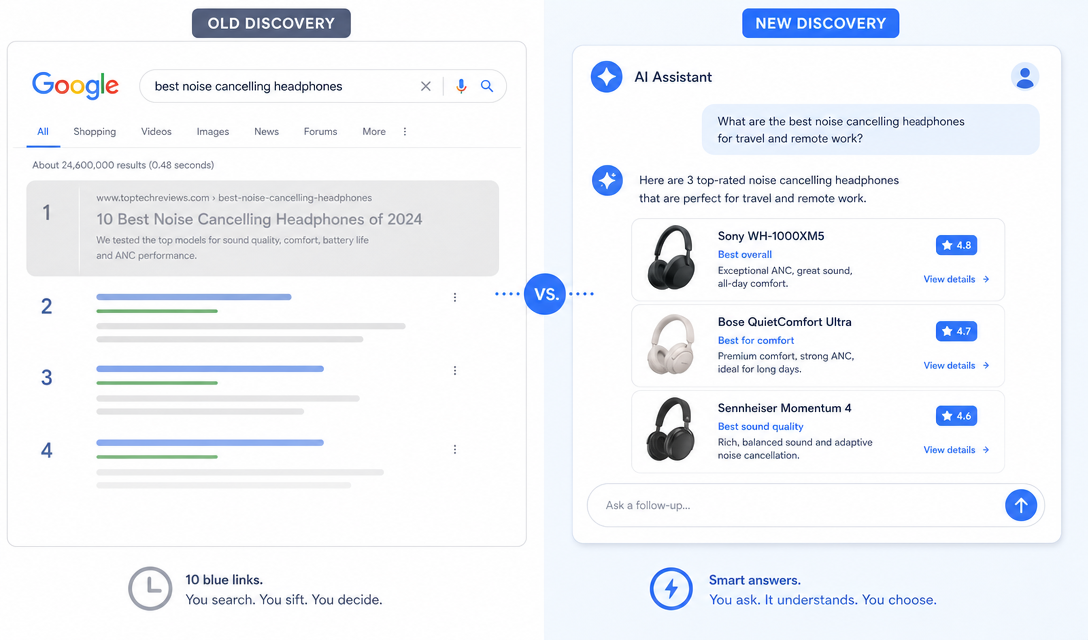
Here's a scenario that should genuinely unsettle you if you've built any part of your distribution around Google rankings.
A B2B buyer in 2026 wants to find the best tool for their use case. They don't open a new tab and type something into Google. They open ChatGPT — or Claude, or Perplexity, or Gemini — describe their situation, and ask for a shortlist. The AI gives them three to five recommendations. They go evaluate those. That's the entire funnel.
Your SEO might be perfect. You might rank #1 organically. And you're completely invisible.
This is the core problem that Generative Engine Optimization (GEO) is trying to solve. And based on what I've been reading — including a detailed breakdown of 10 AEO agencies that someone on Indie Hackers spent real time reviewing — most of the advice floating around right now is either incomplete or actively misleading.
The Shift Is Real, But the Solutions Being Sold Are Mostly Fake
Let me be direct about something: 80% of agencies currently selling GEO or AEO services are just repackaging their old SEO playbooks with a new coat of paint.
They'll talk about "optimizing for AI-generated results" and then hand you a content calendar focused on high-volume keyword clusters. That's not GEO. That's SEO with a new name on the invoice.
The actual mechanics of how LLMs surface recommendations are fundamentally different from PageRank. Google crawls billions of pages and ranks based on authority signals across a massive surface area. A language model pulling from a smaller, more curated set of training data and retrieval sources cares about something different: does this brand get named — by name — as a recommended option in high-intent queries?
Ranking #2 on Google still gets you traffic. Being absent from an AI-generated shortlist gets you nothing.
What Actually Matters for GEO
The research on this is still early, but the signal is clear enough to act on. Here's what I've seen actually move the needle:
1. Answer specific buyer questions with structured precision.
LLMs are essentially doing retrieval on the question the user asked. If someone asks "what's the best tool for X" and your content never directly answers that question in a structured, citable way, you're not going to show up. Generic thought-leadership posts and company blog roundups don't get pulled. Specific, precise answers do.
This is a different content job than what most SEO-optimized pages are doing. Instead of "Top 10 Tools for X (Updated 2026)", you want something that looks more like: "For [specific use case], [product name] works well because [specific mechanism]." Give the AI something it can quote.
2. Get cited by third-party sources that LLMs trust.
This is where the training data and retrieval surface matter. If reputable publications, developer communities (HN, Reddit, Product Hunt), and industry analysts are referencing you by name in the context of solving a specific problem, you accumulate a different kind of authority than backlink profiles.
For a solo founder or small team, this means: every time you're mentioned in a meaningful context — a Reddit thread, an Indie Hackers post, a tech newsletter — that's a citation that can eventually influence whether an AI mentions you. Building in public isn't just a distribution strategy. It's GEO infrastructure.
3. Be specific about your category and use case.
LLMs group products into mental models. If your positioning is vague — "AI-powered platform for modern teams" — you're not going to get categorized reliably. If your positioning is specific — "AI agent that handles X for Y in Z workflow" — the model has something to work with.
Vagueness is a GEO killer. The more specifically you define the problem you solve and who you solve it for, the easier it is for a model to surface you in the right query context.
The Uncomfortable Truth for Bootstrappers
Here's what I actually think about this as someone trying to build to $1M ARR without VC:
GEO doesn't replace SEO — it layers on top of it. Google still sends enormous amounts of traffic, and the basics of technical SEO and content quality still matter. But if you're building your entire acquisition strategy around Google rankings and ignoring the fact that a growing share of high-intent buyers are starting their research in AI engines, you're optimizing for yesterday's funnel.
The founders I'm watching who are growing fast right now are doing something specific: they're writing content that answers precise questions in precise ways, getting named in community discussions, and being deliberate about their positioning in a way that's citable. It's not magic. But it's different from the content-volume game most SEO playbooks push.
I've also seen a pattern among solo founders who've recently crossed $30K MRR — the ones who grew quickly weren't the ones who out-SEO'd their competitors. They were the ones who built enough trust and specificity that they started showing up in recommendations, referrals, and AI-generated shortlists. Distribution problems have always been solved by being the most obvious choice for a specific person. GEO just made that dynamic more explicit.
What I'm Actually Doing About This
For this blog specifically — 23+ languages, technical founder audience — my working hypothesis is that GEO and SEO align more than they conflict when the content is genuinely specific and useful. A post that precisely answers "how do I build an AI agent with Next.js" in Chinese or Japanese, cited on developer forums, probably surfaces in both Google and AI-generated recommendations. The common factor is specificity, not volume.
The one thing I'm cutting: generic "overview" posts written primarily to hit keyword targets. They don't rank as well as they used to on Google, and they definitely don't get surfaced by AI engines. The floor for content quality just went up across the board.
If you're a solo founder thinking about this, start here: pick the three most specific questions your ideal customer asks when evaluating tools in your category. Write one post that answers each of those questions as directly and precisely as possible. Then make sure those posts exist somewhere that gets indexed by the retrieval systems AI engines use — which mostly means high-quality publications and active developer communities.
That's a better starting point than hiring an agency that's going to repackage your old content calendar with a new deck about "AI-era SEO."
シェア
執筆者 Feng Liu
shenjian8628@gmail.com