
Nobody Pays for a General AI Agent — and What That Taught Me About Building RiseMore
What people actually pay for with AI agents — and what a Reddit thread taught me about building RiseMore's architecture. Spoiler: nobody pays for general-purpose assistants. They pay for specific, boring outcomes.

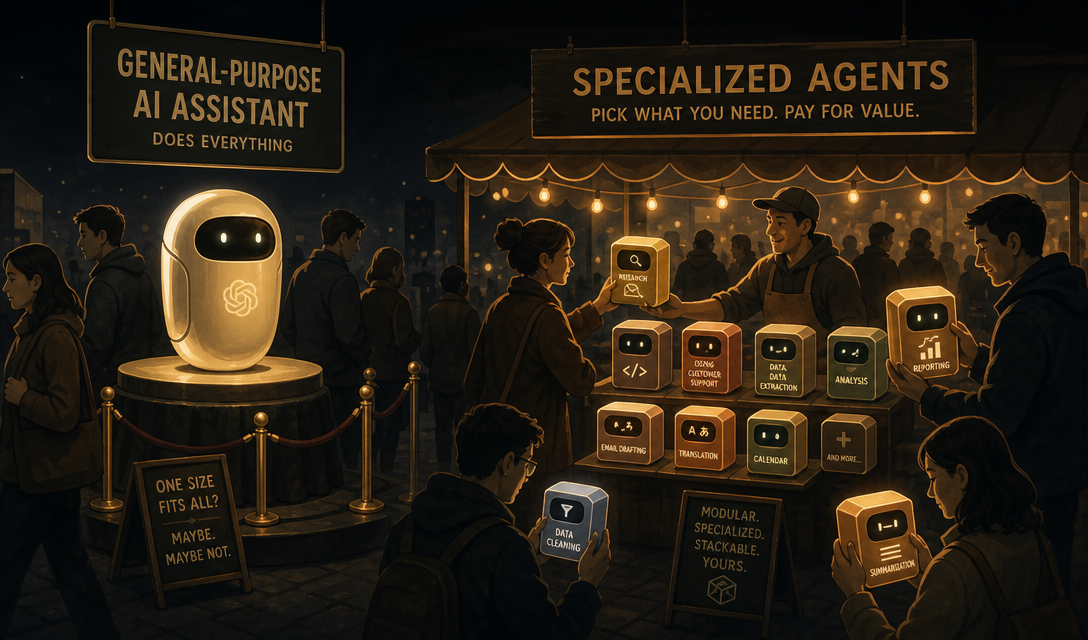
I read a Reddit thread last week that I haven't been able to shake. Someone in r/AI_Agents asked a beautifully simple question: "What AI agents are you actually paying for, and why?"
The answers weren't what the AI industry sells.
Nobody said "a general assistant that does everything." Nobody said "an agent that understands my whole business." The top answers were strikingly narrow: an agent that chases down invoice approvals. An agent that drafts the same weekly ops report. An agent that triages a shared inbox.
The person building Odella put it perfectly: "The tell is usually 'I already know how to do this in 10 minutes, I just never get around to it' — that's the stuff people will actually pay to have taken off their plate."
Another commenter was even more direct: "General-purpose assistants get used once for the demo and then forgotten because there's no forcing function to ever open the tab again."
I sat with that for a while. Because I'm building an AI marketing platform, and the question of what people actually pay for — not what they say they want, not what demos well, but what they reach for their wallet to solve — is the only question that matters.
The Lesson Nobody Wants to Hear
The AI industry has spent two years selling a vision: the general agent that understands your context, makes autonomous decisions, and replaces entire roles. It's a compelling vision. It also has a terrible track record with actual purchasing behavior.
People pay for specificity. They pay for one boring, recurring job done without babysitting. They pay for outcomes, not tasks — as another commenter put it, "leads booked, tickets closed" rather than "tasks completed."
The agents people actually renew are the ones that own a result, not the ones that just do work.
This maps to something I've been grappling with while building RiseMore. When I pitch the full vision — an AI marketing team that handles strategy, content, SEO, competitor tracking, and publishing — it sounds ambitious. Maybe too ambitious. The Reddit thread made me ask: is RiseMore trying to be a general marketing agent that does everything, and therefore risks being the thing nobody pays for?
I think the answer is no, but not for the reason I would have given a month ago.
The Difference Is in the Architecture
What separates the agents people pay for from the ones they abandon isn't scope. It's structure.
Koka Sexton built 15 specialized AI agents to run a content marketing operation. Not one general agent. Fifteen agents, each with defined inputs, process, quality gates, and outputs — like software modules. Research Agent pulls competitive SERP data. Drafting Agent produces copy against a brief. Editor Agent runs three quality passes. His output tripled.
His primary mistake, in his own words: treating AI as a chatbot for advice instead of a structured role with defined editorial standards.
The agents people pay for aren't the ones with the biggest scope. They're the ones with the clearest boundaries.
What This Means for RiseMore
RiseMore isn't one general marketing chatbot. It's a team of specialized agents — research, drafting, editing, SEO, competitor tracking, community discovery, publishing coordination — each owning one outcome. The platform connects them so the output is coherent, but the architecture is modular.
That's not a design choice I stumbled into. It's the shape the problem demanded.
Marketing isn't one job. It's six or seven distinct jobs that compound when they're connected. The founder who needs content doesn't just need a draft — they need research to know what to write about, drafting with product context, editing against brand voice, scheduling for the right channel, and analytics to know if it worked. A general agent that "does marketing" is about as useful as a general employee who "does business."
The Reddit thread confirmed something I'd been feeling but couldn't articulate: the market doesn't want a bigger AI. It wants AI that owns specific, boring outcomes — and it wants those outcomes stitched together into something that feels like forward motion.
That's the bet RiseMore is making. Not that AI can replace a marketing team with one chatbot. That specialized agents, each owning a narrow outcome, connected through shared product context — that's the architecture people will pay for.
The Real Question
The thread had one more insight that stuck with me. The agents people renew aren't the flashiest ones. They're the ones that solved the problem someone "already knows how to do in 10 minutes but never gets around to."
Marketing for solo founders is exactly that problem. Every founder knows they should be posting. They know they should be tracking competitors. They know SEO matters. They know community engagement compounds. They know how to do each of these things in isolation.
They just never get around to all of them consistently. Because building is easier. Because distribution feels non-linear. Because the compound interest of marketing is invisible in the short term.
If RiseMore can own those ten-minute jobs — the research, the drafting, the scheduling, the tracking — and connect them into something that feels like a team, not a to-do list, then it earns the thing general agents never get: a reason to open the tab again.
That's the architecture. That's the bet.
공유하기
작성자 Edward New
shenjian8628@gmail.com