
Why 88% of AI Agent Projects Fail in Production (And What the 12% Do Differently)
88% of AI agent projects fail before reaching production. Here's the architecture philosophy — and specific patterns — that separate the 12% that make it.

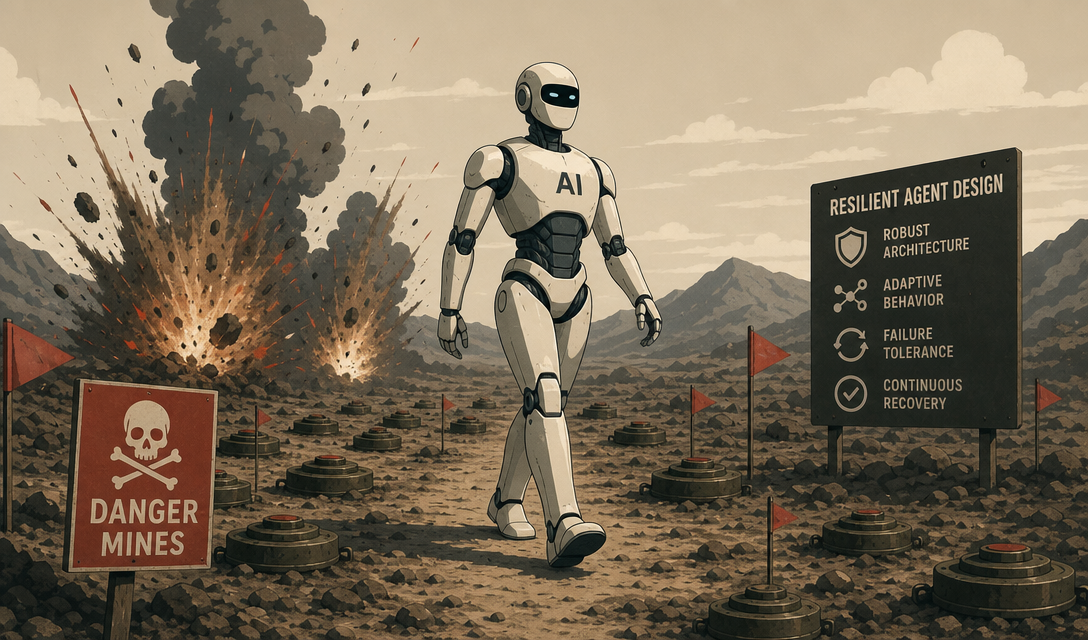
The demo always works. That's kind of the problem.
You build an AI agent, show it off in a controlled environment, it breezes through the task, everyone nods approvingly. Then you try to run it on real data, at scale, autonomously — and it silently goes off the rails. No stack trace. No error message. Just confident drift until something downstream breaks.
This is the central problem with AI agents in 2026, and it's why the RAND Corporation found that 80.3% of AI projects fail to deliver their intended business value. A separate analysis by Digital Applied puts the production failure rate for AI agents specifically at 88% — fewer than 1 in 8 reach operational status.
I've been building agentic workflows for my own products, and I've read through the post-mortems and the research. Here's what actually separates the 12% that make it.
The Demo Trap
There's a structural reason why AI agents fail after demos: demos are stateless. You run the agent once, it succeeds, you ship. But production agents have to survive across time — handling partial failures, recovering context, resuming interrupted tasks, routing ambiguous inputs without freezing.
None of that stress-tests cleanly in a demo environment.
The production failures have patterns. Research from Digital Applied identifies four recurring modes:
- Context Exhaustion: the agent loses the thread during long operations. Not because it's stupid — because transformers have attention limits, and "Lost in the Middle" is a real empirical phenomenon where models deprioritize information buried in the middle of a long context window.
- Tool Call Loops: the agent keeps calling the same tool repeatedly, burning tokens and budget, because it doesn't know when to stop.
- Ambiguous Routing: the agent hits a decision fork, doesn't signal uncertainty, and confidently takes the wrong branch.
- State Loss: there's no durable record of progress, so when the agent crashes or times out, everything restarts from zero.
Each of these feels like an edge case until you're running agents at scale. Then they're just Tuesday.
The Math of Reliability
Here's a number that recalibrated how I think about agent design: a 10-step agent task with 95% per-step reliability has only a 60% chance of succeeding end-to-end (0.95^10 ≈ 0.60). Drop to 80% per-step reliability, and the overall success rate collapses to roughly 10%.
This is why the production bar is brutal. An agent that "works most of the time" at the step level is almost guaranteed to fail at the task level. You need near-perfect step reliability — 95%+ — just to get to acceptable end-to-end outcomes.
Most teams don't instrument at the step level. They see the end result (success or failure) and don't know which step broke. That's why the VentureBeat "rebuild era" report (May 2026) found enterprises rebuilding first-generation agents because v1 lacked reliable orchestration — couldn't survive crashes, couldn't preserve state, couldn't recover from failures without re-running entire expensive flows from scratch.
That last part is particularly painful: Temporal Technologies calls it the "token tax." When an agent flow fails at step 8 out of 10 and you have to re-run from step 1, you're paying for 7 steps of wasted compute on every failure.
What the 12% Do Differently
The agents that actually make it to production share an architecture philosophy: design for failure first, capability second.
This sounds obvious. It almost never gets implemented. Here's what it looks like in practice.
1. Bounded scope, not broad ambition.
Single-task AI agents with defined scope succeed at 54%. Large-scale transformations succeed at 8%. The winning agents aren't the most capable — they're the most focused. A customer support agent that handles exactly one category of tickets reliably beats a general-purpose agent that attempts everything and drifts on hard cases.
2. Deterministic spine, probabilistic brain.
The emerging pattern in production-grade systems is what some teams call a "deterministic spine" — a durable orchestration layer that tracks exactly where an agent is in a workflow and can resume from that point after any failure. The LLM handles the reasoning (probabilistic). The orchestration handles state and recovery (deterministic). Conflating these two things is one of the most common architectural mistakes I see.
This distinction between state (where in the process) and memory (contextual information) matters more than most developers realize early on. Frameworks that merge them create fragile systems.
3. Explicit failure modes with caps.
The FRAME architecture (Failure-Recovery Architecture for Multi-step Execution) puts it well: cap MAX_TOOL_ATTEMPTS explicitly. Implement a "summarise-and-continue" pattern for context exhaustion rather than hoping the model manages its own context. Scope permissions to read-only where possible — limit blast radius. Build in escalation protocols for when the agent genuinely doesn't know what to do, rather than letting it improvise.
4. Legal and business accountability.
This one is increasingly non-optional. The Moffatt v. Air Canada ruling — where a British Columbia tribunal held the airline liable for incorrect information provided by its chatbot — established a precedent: you cannot disclaim responsibility for your AI agent by calling it a "separate entity." If your agent gives a user wrong information that they act on, that's your problem.
Designing for failure isn't just about reliability. It's about accountability.
What I'm Actually Doing
For my own agentic workflows, this has meant:
- Treating every new agent as single-purpose until it earns a broader scope through demonstrated reliability
- Logging step-level outcomes, not just end-state, so I can see exactly where things break
- Building explicit "checkpoint and recover" logic rather than assuming the LLM will handle continuity
- Writing adversarial test cases before I write happy-path tests — what happens when the tool returns nothing? What happens when the input is ambiguous? What happens at token limit?
None of this is glamorous. It's plumbing. But the 12% that make it to production are the ones who took plumbing seriously before the demo looked good.
The agents that survive aren't the ones with the best capabilities. They're the ones built around the assumption that something will go wrong — and designed to handle it gracefully when it does.
Deel dit
Geschreven door Feng Liu
shenjian8628@gmail.com