
94% Use AI for Marketing. 41% Can Prove It Works. Here's What That Gap Taught Me About Building RiseMore.
94% of marketing teams use AI. Only 41% can prove it works — down from 49% in 2025. After months of building an AI marketing platform, here's what the 53-point gap taught me about why measurement infrastructure matters more than model quality.

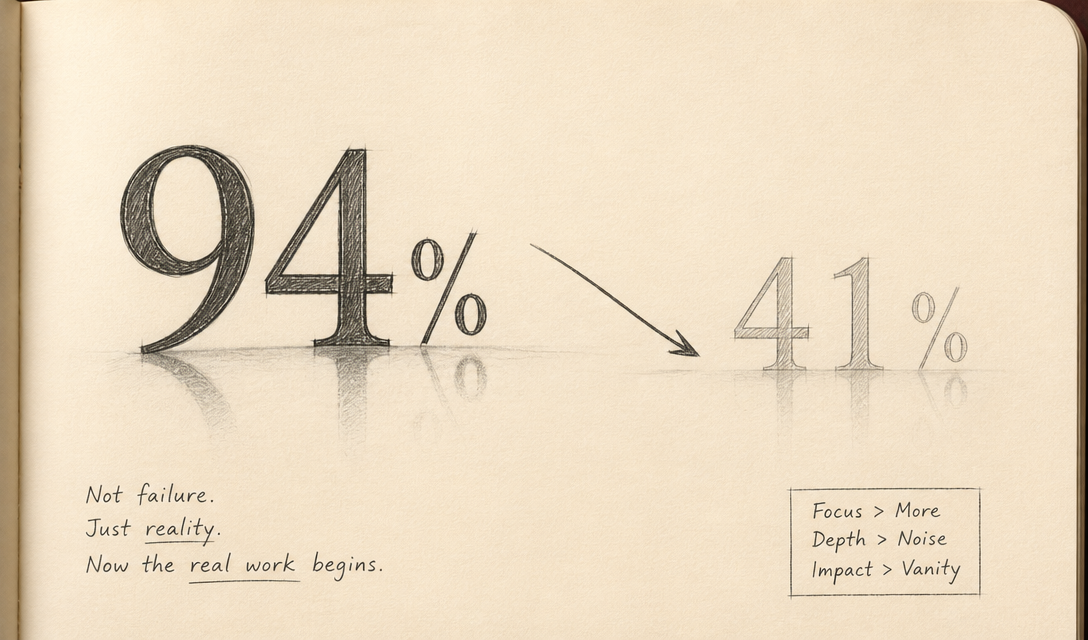
I keep coming back to one stat.
94% of marketing teams now use AI in 2026. Only 41% can prove it delivers business value. And that number is going down — it was 49% in 2025.
More adoption. Less measurable impact. That's not a tool problem. It's an architecture problem.
The Numbers That Haunt Me
Jasper.ai's State of AI in Marketing 2026 report surfaced the 94/41 split. Averi.ai added another layer: 81% of marketing teams lack AI-specific KPIs entirely. They're using AI without any way to know if it's working.
Then there's the true cost. Improvado's research on AI marketing adoption puts the real 6-month cost of adopting AI — accounting for data cleanup, training, and failed experiments — between $50,000 and $500,000. Not the sticker price of the tool subscription. The total cost of making it actually work.
When I read these numbers, I felt something specific. Not surprise. Recognition.
I've been building RiseMore for months now. The question I get most often from other founders isn't "how does the AI work?" It's "how do I know if any of this is working?"
They're asking about measurement. What they're really asking about is trust.
Why Measurement Infrastructure Matters More Than Model Quality
The AI marketing industry spent 2024 and 2025 obsessing over model benchmarks. Which LLM writes better copy? Which one hallucinates less? Which one passes the bar exam?
None of that matters if you can't close the loop from output to outcome.
Here's what I mean. An AI agent can draft 50 social posts in an hour. But if you can't trace which posts drove signups, which ones built audience, and which ones just filled a queue — you're not doing marketing. You're doing content production. Those are different things.
The 81% of teams without AI-specific KPIs aren't failing because their AI is bad. They're failing because they never defined what success looks like for an AI-native workflow. Traditional marketing KPIs — impressions, clicks, conversions — assume a human made the decisions. When an agent makes the decisions, you need different metrics: direction accuracy, brand voice consistency, material utilization rate, approval-to-publish velocity.
What I Built Into RiseMore Because of This Gap
When I started building RiseMore, I had a choice. I could build the best AI writer for solo founders. Better copy, better hooks, better headlines. That's the obvious path.
Or I could build a system where measurement isn't an afterthought — it's baked into the loop.
I chose the second one. Here's what that means in practice:
Every piece of content RiseMore generates is tied to a saved material — a customer quote, a competitor move, a product update, a market trend. You can trace every post back to its source. Over time, you can see which types of materials produce the best-performing content. That's not just measurement. That's a learning system.
The competitor radar doesn't just tell you what competitors launched. It tracks threat levels over time, so you can see whether a competitor is accelerating or fading. The SEO agent doesn't just suggest keywords. It shows you which pages are gaining or losing ground, and ties recommendations to specific pages.
These aren't features. They're the measurement layer that the 81% are missing.
The Real Cost of the 53-Point Gap
The 53-point gap between adoption and provable impact isn't academic. It has a dollar figure.
When a team spends $50,000 to $500,000 adopting AI and can't prove it worked, the CFO kills the budget. The CMO goes back to agencies. The AI experiment gets filed under "we tried it, didn't work."
But the AI didn't fail. The measurement infrastructure was never built.
For solo founders, the dynamic is different but the cost is the same. When you spend three months posting AI-generated content and see zero traction, you don't have a CFO to blame. You just have the quiet feeling that marketing doesn't work for people like you. You go back to building. The distribution gap widens.
That's the real thing I'm trying to solve. Not better AI copy. Better feedback loops. So marketing doesn't feel like shouting into the void — it feels like a system that tells you what's working and what isn't.
94% adoption. 41% provable impact. The gap is where the real work lives.
Udostępnij to
Napisane przez Edward New
shenjian8628@gmail.com