
The AI Tool Pricing Trap: What the June 2026 Billing Chaos Means for Bootstrapped Founders
Four major AI developer tool pricing collapses in one month. Here's what June 2026's billing chaos means if you're building bootstrapped.

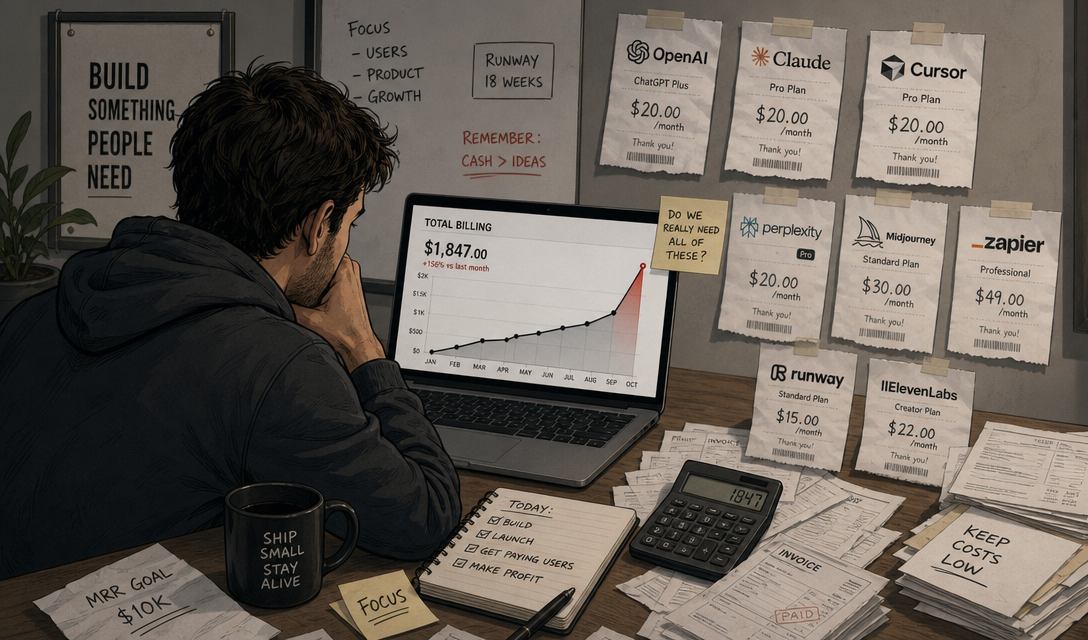
June 2026 had four major developer tool pricing collapses in a single month. I watched all of them happen and thought about what they meant for someone building a bootstrapped product on AI infrastructure.
Here's what actually happened — and what I think it signals.
The Billing Events
GitHub Copilot moved from flat-rate subscriptions to metered AI Credits on June 1. Developers reported bill increases from $29 to $750 in a single cycle. One developer hit their monthly credit cap by day 9. Another exhausted all fast credits in a single day of normal use. The community thread on GitHub's own discussion forum describes the new system as "absolute robbery."
Microsoft, meanwhile, told thousands of engineers to stop using Claude Code by June 30 — after per-engineer costs reached $2,000 per month. A single bug-fix task using Claude Sonnet can consume between 400,000 and 2 million cumulative input tokens. In an agentic loop, costs compound fast.
Anthropically's June 15 billing changes moved Claude Code from a bundled subscription to dedicated credit pools at full API rates — the same week Microsoft decided the bill was too high.
Before that: Google shut down Gemini CLI on June 18 with no warning, forcing migration to a closed-source replacement. Windsurf was rebranded to Devin Desktop after a $250M acquisition, and users had until June 25 to test migration before the old system went end-of-life.
Four tools. One month. A pattern.
The Pattern Isn't Surprising
What's happening isn't an accident. It's a structural shift: the AI tool market subsidized adoption with flat-rate pricing while burning through VC money. Now the math is catching up.
Microsoft's cancellation "put a dollar figure on enterprise agent spend" — the gap between a $20/month subscription and the actual API costs of continuous agentic workflows is now quantified and it's uncomfortable.
The high-end models cost 20-50x more per output token than efficient models for what the labs describe as "the last 7-15 points of benchmark performance." Claude Fable 5 costs $10 per million input tokens and $50 per million output tokens. At agentic loop volumes, that scales fast.
The result: every major AI developer tool has now abandoned flat-rate pricing. The race to "free" (or cheap) was always a race to fundraise and then reprice later.
What This Means If You're Building Bootstrapped
I'm building VibeCom without institutional funding. That means every dollar of infrastructure cost is a real dollar — not a line item in a burn rate. And it means I think about this differently than a funded startup does.
Here's what I've come to believe: the tools you build on top of VC-subsidized infrastructure are only as stable as the funding round behind them. When the money pressure changes, the pricing changes. When the acquisition happens, the product philosophy changes. When the enterprise customers arrive, the solo-founder tier gets deprioritized.
This isn't cynicism — it's just how incentives work.
So what do you do about it?
The Practical Response
First, understand the cost architecture of every AI tool in your stack. The shift to metered billing isn't going away — it's spreading. Know whether you're paying per-token, per-request, or flat. Know what happens to your bill when you use the tool heavily.
Second, prefer human-in-the-loop workflows where the cost is bounded. The pricing crises in June 2026 all came from the same root cause: fully autonomous agentic loops don't have a natural stopping point. They run until they succeed, fail, or hit a limit. Every iteration costs money at API rates.
A tool that generates a draft and waits for your approval doesn't spiral. A tool that runs autonomously until you stop it can. This isn't a moral argument — it's an economics argument.
Third, watch for platform consolidation risk. When Cursor was acquired by SpaceX, when Windsurf was folded into Devin Desktop, when Gemini CLI went closed-source overnight — in each case, the developers who had built workflows around those tools found themselves migrating with short notice.
MCP-native workflows help here: the protocol is tool-agnostic. If one IDE goes sideways, you can move without rebuilding everything.
Finally: flat-rate pricing from a sustainable business is worth more than it sounds. Predictable costs aren't glamorous. But when four billing crises happen in one month, "you know exactly what you'll pay" becomes a real differentiator.
The Honest Version
I built VibeCom with $100/month flat-rate pricing not because I had a clever strategy, but because I hate uncertainty in my own tool costs. I didn't want to build a product that would surprise people with their bill.
The June 2026 pricing events validated that instinct. Not because I predicted them — I didn't — but because they showed what happens when tools don't think about this from the beginning.
The AI tool ecosystem is maturing. Maturing means real pricing, real costs, and real decisions about which tools are worth what they cost. Bootstrapped founders should think about that now, before the next billing surprise arrives.
Compartilhar
Escrito por Feng Liu
shenjian8628@gmail.com