
The $50 Billion Infrastructure Question: What LLM Costs Mean for Developers Building AI Agents in 2026
OpenAI spends $50B on infra while DeepSeek is 34x cheaper. Here's what LLM economics mean for solo founders building AI agents in 2026.

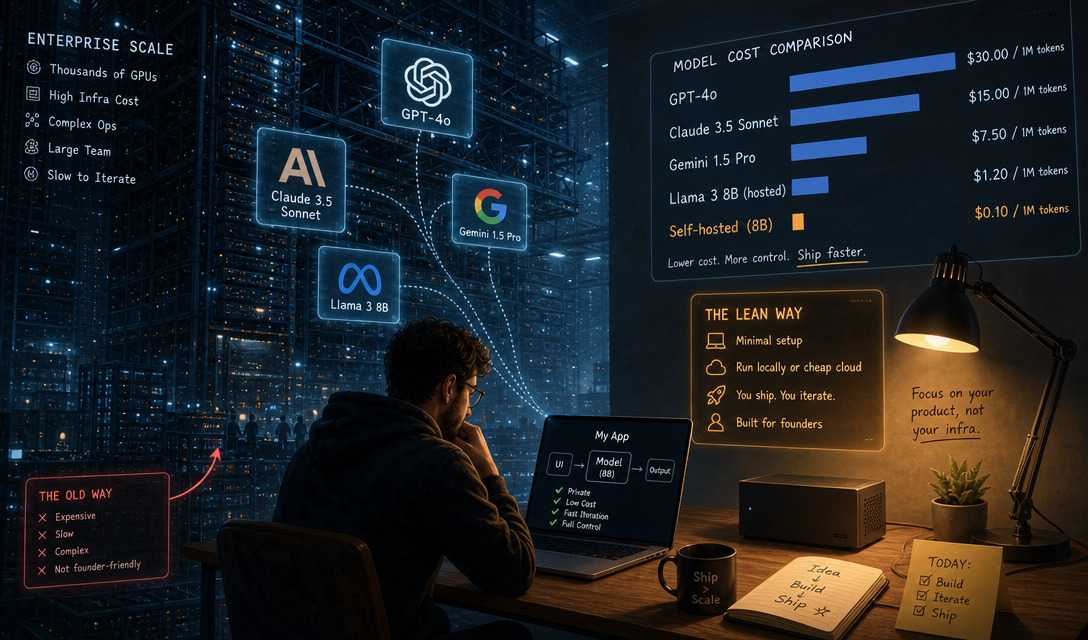
OpenAI's projected infrastructure spend in 2026 is $50 billion. That's a 1,667x increase since 2017.
Let that sink in for a second. The company that made AI accessible to the world is now spending more on compute than most countries spend on defense. And yet, DeepSeek V4's output costs 34x less than GPT-5.5 per token. These two facts, held together, tell you something important about where the real opportunity is if you're building AI agents as a solo founder.
This isn't a post about which model is "best." It's about understanding how the economics of LLMs in 2026 should actually change your architecture decisions when you build AI agent workflows.
The Benchmark Gap Is Closing Faster Than Anyone Expected
A few weeks ago, Claude Opus 4.7 posted an 87.6% score on SWE-bench Verified — the industry's most demanding test of autonomous software engineering. That's up from 80.8% for Opus 4.6. GPT-5.5 is running at 82.7% on Terminal-Bench 2.0. DeepSeek V4 is trading blows at a fraction of the price.
Here's what this means in practice: the performance gap between frontier and near-frontier models is shrinking. What was a meaningful capability difference 12 months ago is increasingly a rounding error for most production use cases.
But the cost gap is doing something different. It's widening.
DeepSeek V4 is 34x cheaper than GPT-5.5 for standard output. DeepSeek V4-Pro handles bulk workloads at 7x cheaper. Claude Opus 4.7 introduced an xhigh thinking budget tier — which is genuinely powerful for complex agent reasoning, but it's not cheap. The 1M token context window on Opus 4.7 sounds impressive until you start running long agent loops and watching your monthly bill.
Why This Matters for How You Build AI Agents
If you're building AI agents in Next.js or any modern stack, you're making a bet every time you hardcode a model choice into your architecture. The developers who are going to win over the next 18 months are the ones building model-agnostic routing from the start.
This isn't a new idea — it's just more urgent now. When Anthropic, OpenAI, Google DeepMind, Microsoft, and xAI are all subject to U.S. Department of Commerce pre-release safety testing requirements, release timing is now a regulatory variable. You can no longer predict when the next frontier upgrade arrives. Your agents need to be able to swap models without re-engineering your entire system.
The practical architecture looks like this:
- Cheap, fast model for high-frequency tasks: classification, routing decisions, structured data extraction. DeepSeek V4 Flash fits here — >95% cache hit rate on programming workloads, compatible with Claude Code's tooling via API override.
- Mid-tier model for the bulk of reasoning: DeepSeek V4 Pro or Claude Sonnet-class for the 70% of tasks that need real capability but don't require the frontier.
- Frontier model on a tight budget: Claude Opus 4.7 with
xhighthinking for the 5-10% of decisions that genuinely need maximum capability — complex multi-step planning, security-sensitive reasoning, evaluation loops.
This isn't vibe coding. This is what production AI agent architecture actually looks like when you're a solo founder watching your margins.
The Context Window Arms Race Has a Floor
One of the more interesting signals from May 2026 is Subquadratic, a startup that just raised $29M in seed funding to build SubQ — an LLM that uses subquadratic sparse attention with a 12 million token context window.
The reasoning is compelling: standard transformer attention is O(n²) with sequence length. As agents need longer context to handle complex multi-session workflows, the compute cost scales quadratically. SubQ's architecture is positioned as the solution for real long-horizon agents.
But here's the question worth asking: do most solo founders actually need 12 million tokens of context? In my experience building agents, the answer is almost always no — not because the capability wouldn't be useful, but because the bottleneck is almost never context length. It's prompt design, state management between agent steps, and knowing when to truncate versus summarize.
The context window arms race is real and will matter for certain use cases (legal document analysis, large codebases, extended conversation memory). But for the typical AI SaaS that a solo founder is building in 2026, a 1M token window — already available in Claude Opus 4.7 and Grok 4.3 — is sufficient for nearly every workload.
Don't optimize for the constraint you don't have yet.
The Regulatory Variable Nobody Is Pricing In
Here's the piece that I think most developers are underweighting: the U.S. Department of Commerce now requires pre-release safety testing for five major labs — Anthropic, OpenAI, Google DeepMind, Microsoft, and xAI. Frontier model release timing now has a regulatory dependency.
This is actually good news for solo founders, though it doesn't feel like it. It means the cadence of disruptive model releases will slow slightly. You have more time to build on a stable foundation before the next capability jump arrives and reshapes your assumptions.
But it also means: the labs that aren't subject to this testing — open-weight models, Chinese frontier labs — have a structural speed advantage in shipping capability. Kimi K2.6 beating Claude, GPT-5.5, and Gemini in a programming challenge last month wasn't a fluke. It was a signal.
What This Means for Your Agent Stack Today
If you're deciding how to build AI agents for a product you want to get to $1M ARR without VC, here's how I'd frame the decision:
Don't architect around a single provider. The landscape is too volatile. Abstract your model calls behind a routing layer — even a simple one. The 15 minutes you spend adding model abstraction today will save you days of refactoring when your primary provider changes pricing, context limits, or rate structures.
Price your token budget before you ship. Claude Opus 4.7 at xhigh thinking is powerful. It's also expensive at scale. Map out your expected token consumption per user session before you launch, not after. The founders who are getting burned on Claude Code costs right now are the ones who didn't do this math early.
Treat model benchmarks as a starting point, not a decision. SWE-bench Verified 87.6% sounds impressive, but it's an autonomous software engineering benchmark. If your agent is doing customer support, content generation, or data extraction, that number is almost irrelevant. Test your specific workload with your specific data.
Build with the regulatory horizon in mind. Release timelines have a new variable. Plan your roadmap assuming 6-month gaps between major frontier model releases rather than 3-month gaps.
The $50 billion OpenAI is spending on infrastructure isn't your problem. Your problem is building something that works reliably, ships fast, and doesn't collapse every time a new model drops. The architecture principles that solve that problem are the same in 2026 as they were before the AI boom — abstract your dependencies, know your costs, and test on your actual workload.
The models are getting better. Your job is to stay focused on what you're actually building.
If you're working through AI agent architecture decisions for your own SaaS, I document what I'm building and learning at mynameisfeng.com — across 23 languages, for the developers who don't default to English-only resources.
Поделиться
Автор Feng Liu
shenjian8628@gmail.com