
From $0 to $80M Exit in Four Months: What Vibe Coding Actually Teaches Us About Solo Founder AI Tools
Maor Shlomo built Base44 with vibe coding and sold it for $80M in four months. The lesson isn't what you think — it's about which solo founder AI tools to trust with what.

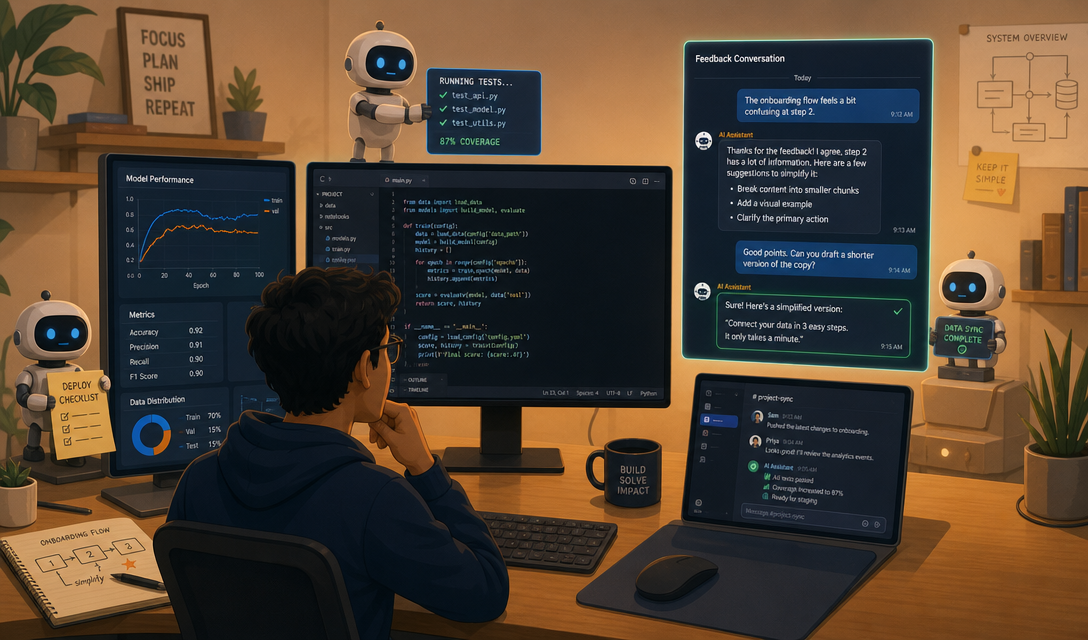
Maor Shlomo founded Base44 in early 2026. By describing software to a chatbot instead of writing code by hand, he generated $1.5M in revenue in one month. Four months later, Wix acquired Base44 for $80M.
He had replaced a 100-person team structure with AI agents. He automated product management, QA, and development. He built automations to crawl his own platform for UX issues and convert code changes into marketing content automatically.
Then he automated customer support — and that's when things started to drift.
This is the part of the vibe coding story that doesn't make the headlines.
What "One Person = 10-Person Team" Actually Means
The stat that gets shared the most right now: U.S. solopreneurs are expected to exceed 41 million in 2026. Average headcount for companies less than a year old has dropped from 7–9 people (20 years ago) to 3–4 today. Sam Altman has openly said he's betting on the first one-person billion-dollar company.
The narrative follows from this: the bottleneck is no longer building. It's distribution.
That's mostly true. But Shlomo's story adds a nuance worth sitting with: the thing AI can't replace isn't the code or the marketing copy — it's the signal you get from talking to users at the moment they're frustrated.
When he automated customer support away, he removed himself from the product feedback loop. The product direction started to float. Some human oversight, he concluded, isn't a concession — it's the source of product direction itself.
This is something that most solopreneur AI tools don't tell you in their pitch.
The Tools Are Real, But So Are the Tradeoffs
Cursor crossed 1 million monthly active users in early 2026. 34% of new micro-SaaS products launched in Q1 2026 were built by founders with no prior programming experience — some generating $5K–$50K MRR. Dana Snyder used Replit to build a consultancy platform for nonprofits that previously couldn't afford consultants, serving 93% of U.S. nonprofits with zero engineering staff.
The tools genuinely work. If you're a technical founder using AI tooling to compress what would have been a 6-month build into 6 weeks, you already know this.
The trap isn't in the tools. It's in the model of the business that the tools tempt you toward.
When everything is automatable in theory, the reflex is to automate everything. The ones who scale past $1M ARR tend to be more selective about what they keep human — not because they can't automate it, but because the signal loss isn't worth it.
The Leverage Stack Worth Copying
If you look at what's actually working for profitable solo founders right now, the pattern is less "everything on autopilot" and more "high-leverage human judgment + automated execution." A few specifics:
Feedback loops stay human. The founders who are scaling treat cancel flows, support conversations, and onboarding drop-offs as intelligence collection — not cost centers. Flidget's Vishal Chaudhary reached $4K MRR almost entirely through word-of-mouth by having real conversations at the exact moment users were about to leave. That interaction can't be templated without losing the thing that makes it work.
The build is heavily automated. This is where solopreneur AI tools shine without caveats. Code generation, testing pipelines, deployment, translations, SEO scaffolding — all of this is fair game for aggressive automation. Traditional startups spend up to 70% of capital on salaries. Solo founders running on $300–$1,200/year in AI tools are structurally different businesses.
Distribution is the actual moat. Midjourney runs at $200M ARR with 11 employees — $18M per employee. The constraint isn't building. The solo founders who stall out have great products and no distribution. This is where most time and intentionality should go after the first users are paying.
What I'd Actually Do Differently If Starting Today
If I were starting fresh in 2026 with the solo founder AI tools available now, here's the honest sequencing:
- Ship the smallest version that creates real value — not a polished MVP, a functional proof. Get 5 paying customers before optimizing anything.
- Keep the support line human for the first 3 months. Not because it doesn't scale — because that's when you're learning what the product actually is.
- Automate the build ruthlessly — use Claude Code, Cursor, or whatever fits your workflow. The goal is compress time-to-feature by 10x, not replace thinking.
- Build distribution from day one. Writing, building in public, showing up where your ICP hangs out. This is the one thing that compounds.
- Only then automate the feedback loops — once you know what signal you need, you can build systems that capture it without losing fidelity.
The Maor Shlomo story isn't an argument against solopreneur AI tools. It's an argument for knowing which parts of the business need your attention before you hand them to a bot.
The first one-person billion-dollar company might appear in 2026. What it'll look like, I suspect, is someone who automated the right things and stayed human about the rest.
Bunu paylaş
Yazan Feng Liu
shenjian8628@gmail.com