
The Invisible Tax: Why Most AI Tools Don't Actually Make You Faster
NBER surveyed 6,000 CEOs and found that 90% of firms using AI report zero productivity gain. The reason isn't the AI — it's the invisible tax of coordination overhead. Here's what that means for solo founders building with AI.

I read a working paper last week that I haven't been able to stop thinking about.
The NBER — the National Bureau of Economic Research, not exactly a hype machine — surveyed nearly 6,000 CEOs and senior executives across the US, UK, Germany, and Australia. They asked one question: is AI actually making your company more productive?
69% of firms are actively using AI.
90% of those firms report zero impact on productivity or employment over the past three years.
Not "modest gains." Not "mixed results." Zero.
The paper identifies two narrow exceptions — software coding and customer service, both showing roughly 30% productivity gains — but the core finding is blunt: local task-level AI gains do not automatically compound into organizational productivity.
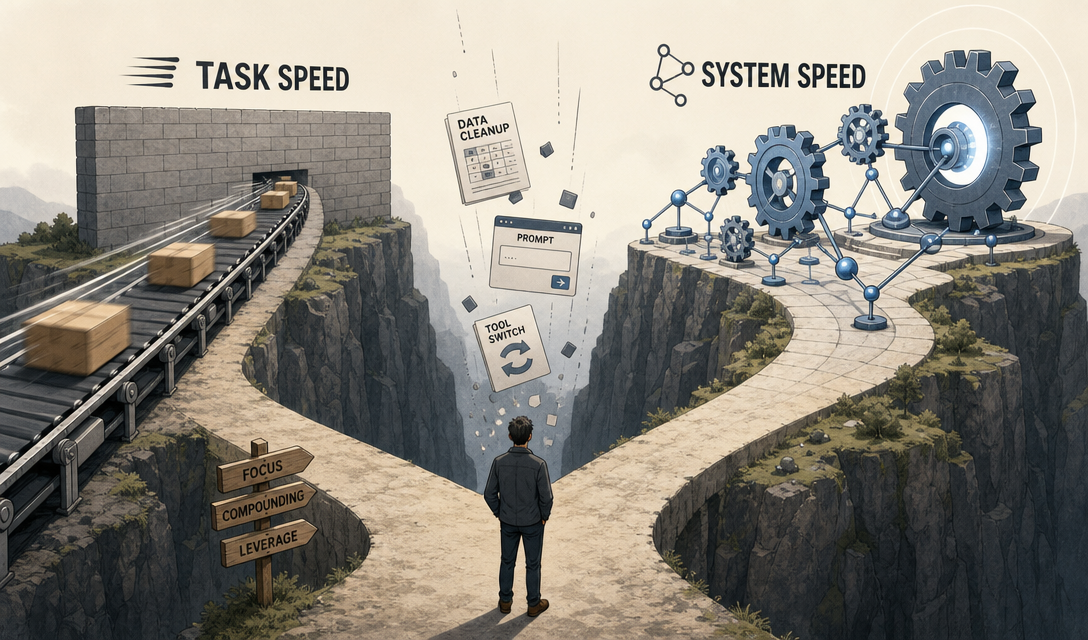
The researchers call it "the invisible tax." The time/quality/cost trade-offs haven't vanished. They've moved to less visible areas: data cleanup, prompt iteration, output review, tool-switching overhead.
This hit me hard because I've been living it.
The Tax I Pay Every Day
I'm building VibeCom as a solo founder. I use AI for everything — coding, research, content drafting, competitive analysis. On paper, I should be 10x more productive than a founder five years ago.
Some days I am. Other days I spend three hours debugging an AI-generated component that would have taken me 45 minutes to write from scratch. Or I burn an afternoon iterating prompts to get a blog draft that still needs a full rewrite.
The AI made the individual task faster. The overall output? Harder to measure. Sometimes net positive, sometimes net negative.
This is the invisible tax in microcosm. And it's not just a coding problem.
Marketing's Version of the Invisible Tax
The AI marketing tool landscape has its own version of this.
A small business replaces their human copywriter with AI. Saves £1,400 a month. Email open rates drop from 31% to 24%. Click-through rates fall by nearly a third. The AI optimized for correctness — not for the specific brand voice that made the emails work.
Or take the fragmentation problem Factors.ai documented: teams end up running ten subscriptions, five dashboards, and three separate attribution systems simultaneously. Each tool individually "affordable" at $49 or $99 a month. Together: a tangled mess of overlapping data and conflicting metrics. The real cost isn't the subscription — it's the coordination overhead.
This is the invisible tax applied to marketing: you save time on content creation, but you spend it on tool-switching, data cleanup, and prompt engineering. The work didn't disappear. It moved.
And for solo founders, this hits differently. You don't have a team to absorb the coordination overhead. Every tool switch, every prompt iteration, every cleanup task comes out of your time — the same hours you could spend talking to users, improving the product, or honestly, sleeping. Context switching kills momentum in a way that's hard to explain until you've lost a whole afternoon to it.
This is the part that doesn't show up in the productivity statistics: marketing falls apart when you go heads-down on the product. Then you surface, post a few things, get nothing back, and conclude that distribution just isn't working. But you weren't really running distribution. You were running a start-stop pattern that looks like distribution from the outside.
The Architecture Problem
The NBER finding exposes a structural issue with how most AI tools are built.
They're task-level accelerators. They make one thing faster — writing, coding, scheduling — without understanding the system that thing lives inside. An AI copywriter doesn't know your product positioning. An AI scheduler doesn't know your audience. An AI analytics tool doesn't know your competitive landscape.
Each tool solves its narrow problem. None of them solve the coordination problem.
This is why I built VibeCom differently.
Instead of starting every session from a blank prompt, VibeCom builds a product knowledge base first. It holds your positioning, brand voice, customer stories, competitive context, and channel history. Every draft pulls from that context — not from the statistical average of the internet.
The difference isn't better AI. It's better architecture. An agent that knows your product makes different decisions than a tool that starts from zero.
What This Means If You're Building Alone
The NBER finding isn't an argument against AI. It's an argument against using AI as a collection of disconnected task accelerators when what you actually need is a system.
For a solo founder, "system" doesn't mean enterprise infrastructure. It means: does the AI know enough about your product to make decisions, or are you still making every call yourself?
If you're shipping but no one sees it, the problem probably isn't the quality of what you're building. It's that you're running ten tools and none of them know what you're actually trying to say.
That's the line between the 90% reporting zero gain — and the 10% who are actually getting faster.
分享
作者 Feng Liu
shenjian8628@gmail.com